EV Charging · August 1, 2026 · LeMaster Electric
Washington’s EV Story Is Getting Bigger Than EV Chargers
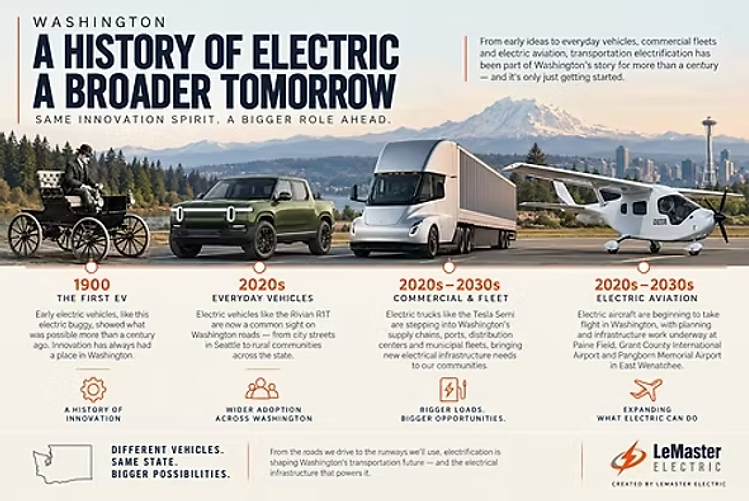
Washington’s EV story is expanding beyond passenger vehicles and public chargers into fleet electrification, electric aviation, and a much bigger electrical infrastructure market.
For a while, transportation electrification was mostly discussed in terms of passenger vehicles and public charging stations.
That’s changing pretty quickly.
Washington is now looking at a much bigger electrical infrastructure picture: more public charging, larger fleet deployments, higher-powered DC fast charging and, increasingly, electric aviation.
And the numbers behind that shift are hard to ignore.
Washington’s Transportation Electrification Strategy estimates electricity consumption from light-, medium- and heavy-duty EVs could grow from about 1.4 terawatt-hours in 2025 to 14 terawatt-hours by 2035.
That is roughly 10x the electrical demand in a decade.
That number caught my attention because it changes the conversation.
We’re not just talking about installing more chargers. We’re talking about the electrical services, distribution, utility capacity and infrastructure required to support them.
And 14 TWh is a hard number to visualize, so here’s a local comparison.
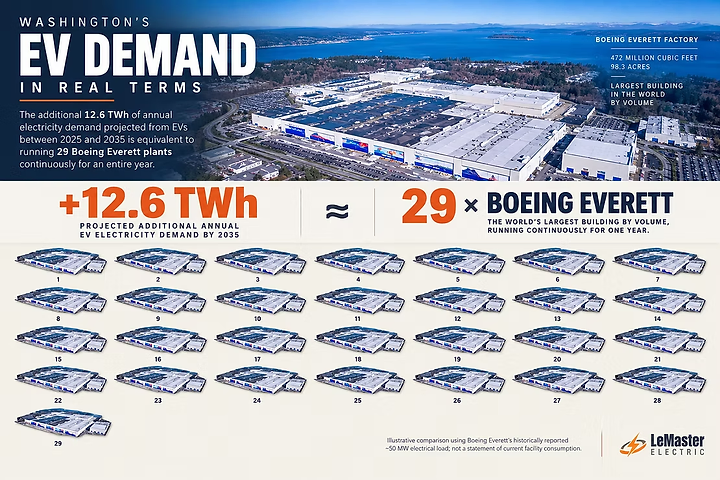
Boeing’s Everett assembly building is the largest building in the world by volume, enclosing roughly 472 million cubic feet across a 98.3-acre footprint.
Using its historically reported electrical load of approximately 50 MW as a scale comparison, the additional 12.6 TWh of annual EV electricity demand projected between 2025 and 2035 would be equivalent to running about 29 Boeing Everett plants continuously for an entire year.
The infrastructure is already being funded
Washington isn’t waiting until 2035 to start building.
Through the Washington Electric Vehicle Charging Program, the state has invested approximately $135 million across 618 projects supporting more than 5,500 charging ports.
The latest round alone includes 754 new charging ports, including 204 DC fast-charging ports, expected to come online by late 2027.
More interesting to me is where those chargers are going.
This isn’t only highway fast charging. State funding is supporting public locations, workplaces, multifamily properties and fleet charging.
But the publicly funded side is only part of the market.
Publicly available charging-network data show more than 4,300 public charging stations across the Seattle–Tacoma–Bellevue market, including more than 600 DC fast chargers.
In the previous 90 days alone, roughly 370 new stations were added to that market.
Growth is happening outside Puget Sound, too, with approximately 650 stations in the Spokane area, 420 around Mount Vernon–Anacortes, and 370 in the Tri-Cities as of September 2026.
Public charging counts reflect an aggregate of publicly available charging-network data as of September 2026. Station totals may include multiple charging ports at a single location and may change as new sites are added, activated, or removed.
That matters because fleet charging starts changing the scale of the electrical work.
One passenger vehicle plugging into a charger is one thing.
A facility planning to charge dozens of delivery vans, municipal vehicles, school district vehicles or commercial trucks is a completely different infrastructure conversation.


Fleets are the next big electrical load
Washington’s commercial vehicle requirements are also ramping up.
For Class 4–8 commercial vehicles, the state’s zero-emission sales requirement rises from 11% in model year 2025 to 75% by 2035.
If you don’t regularly speak in truck classifications, that means vehicles like box trucks, delivery trucks, larger utility and service trucks, work trucks, school-bus-sized vehicles, refuse trucks and other heavy commercial vehicles.
That doesn’t mean every fleet suddenly becomes electric in 2035.
It does mean more businesses are going to start asking a question that is much bigger than “where should we put the chargers?”
Can our electrical infrastructure actually support the fleet we plan to have?
That one deserves its own post.
And then there’s electric aviation
This is the part I think is especially interesting in Washington.
Electric aircraft charging is no longer just a concept being discussed somewhere else.
WSDOT has already studied future electric-aircraft energy and peak-power demand at Paine Field and Grant County International Airport, specifically looking at whether the surrounding electrical grid could support electric aircraft operations over the next one to two decades.
Pangborn Memorial Airport in East Wenatchee has also been identified for an electric aircraft charging station and strategic planning project.
So what does electric aviation actually mean to the average person?
Probably something a lot less dramatic than the phrase makes it sound.
The early applications are more likely to include smaller regional aircraft, short-distance flights, eVTOL aircraft and electric ground equipment rather than a battery-powered 737 replacing a cross-country flight.
For a passenger, the eventual experience may be remarkably normal.
You get on the aircraft.
It just happens to plug in instead of fuel up.


This is becoming an electrical infrastructure market
EV charging is still EV charging.
The electrical fundamentals haven’t suddenly changed because the equipment has a different logo on it.
What is changing is the size and variety of the loads being added.
Public DC fast charging brought larger services and high-powered equipment into more commercial sites. Private charging networks, retailers and property owners are adding infrastructure alongside the publicly funded network. Fleet electrification concentrates more charging demand at individual facilities. Aviation introduces another operating environment and another category of charging equipment altogether.
The technology will keep changing.
So will the vehicles.
The interesting part is how many different things we’re starting to plug in — and how much electricity it’s going to take to do it.